

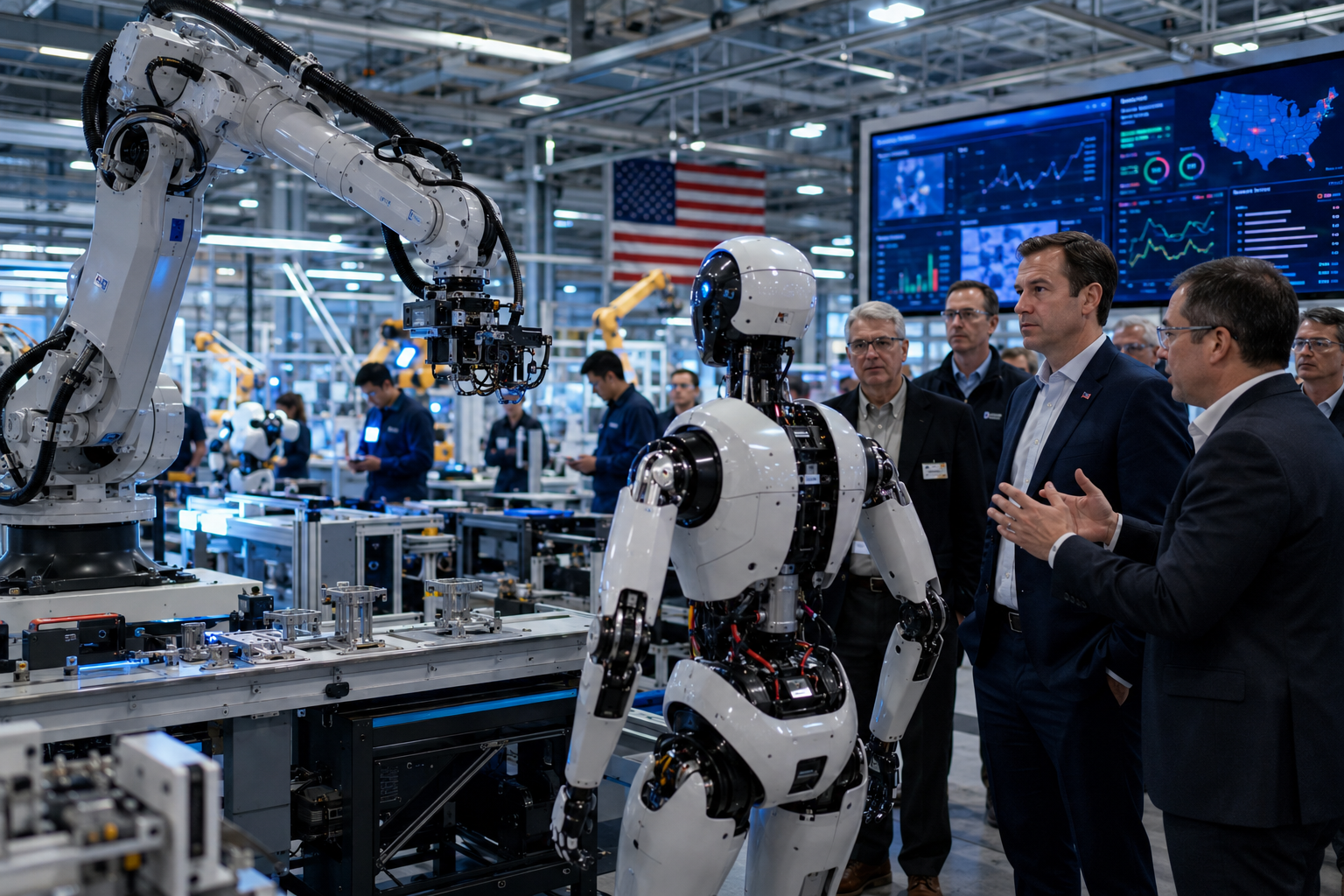
The new Chinese robots review in Washington may sound like a narrow trade story at first, but it is quickly turning into something much bigger. What started as a reported closed-door warning from US Commerce Secretary Howard Lutnick is now raising serious questions about national security, manufacturing, subsidies, and the future of automation in America. At the center of it all is one increasingly urgent concern: what happens if the next wave of industrial and humanoid robots in the US market is heavily shaped by Chinese state-backed companies?
That is why the Chinese robots review matters so much. This is not just about factory equipment or one more trade dispute with Beijing. It is about who builds the machines that could soon work in warehouses, hospitals, labs, public infrastructure, and even sensitive government environments. If Washington believes those robots are being pushed into the US market with the help of state subsidies, then the issue stops looking like normal business competition and starts looking like the next big technology battleground.
And that is exactly where this story is heading. The United States is already locked in a broader fight with China over AI, semiconductors, telecom equipment, and industrial policy. Now robotics is moving into that same high-stakes category, where technology is no longer judged only by price or performance, but by who controls it, who benefits from it, and who could be exposed by it.
Why the Chinese Robots Review Has Suddenly Become a Big Story
The Chinese robots review became a major talking point after Reuters reported on a Politico story saying that Howard Lutnick told executives in a closed-door meeting that the Commerce Department is reviewing Chinese state-subsidized robotics imports and could take action after that review is complete. Reuters said it could not independently verify Politico’s account, but the message itself was clear enough to send a signal through the technology and manufacturing world.
According to the report, Lutnick warned that the US does not want state-subsidized robotics attacking us in America, adding that the coming “arms race” will involve robotic manufacturing. He reportedly said the United States needs to make sure those systems are produced in America rather than being dominated by subsidized foreign imports.
That language matters because it completely changes the frame of the conversation. The Chinese robots review is not being described as a technical customs issue or a narrow trade complaint. It is being described as a strategic challenge tied to the next generation of industrial power.
Howard Lutnick’s Warning Shows How Washington Now Sees Robotics
One of the biggest takeaways from the Chinese robots review is not just that a review is happening. It is how Howard Lutnick reportedly described the risk.
His comments suggest that the Trump administration is beginning to treat robotics the same way Washington now treats semiconductors and advanced AI systems: as a strategic technology that could shape the future of economic power, industrial strength, and national security.
That is a major shift.
For years, robots were often discussed as productivity tools, factory helpers, or futuristic consumer devices. But the Chinese robots review shows that Washington is increasingly viewing them through a much harder lens. The question is no longer just whether robots can make production cheaper or more efficient. The question is whether the US wants to rely on foreign, state-backed robotics systems in critical parts of its economy.
Why the “Arms Race” Language Matters
Calling robotics an arms race is not a casual phrase. It signals that the administration sees robot production as part of a bigger competition over technological dominance.
That matters because robotics can influence:
- Manufacturing productivity
- Warehouse automation
- Critical infrastructure operations
- Data collection and remote sensing
- Military and dual-use technology development
Once you look at robotics through that lens, the Chinese robots review stops being a story about cheap imports and starts looking like a long-term contest over who controls a foundational technology.
Why State-Subsidized Chinese Robots Are Raising Red Flags
The heart of the Chinese robots review is not simply that the robots are made in China. It is that they may be supported by state subsidies, giving Chinese firms the ability to scale faster, price more aggressively, and undercut competitors in ways US officials see as unfair or strategically dangerous.
That concern fits a pattern that has already been growing in Washington. Over the past few months, US lawmakers have repeatedly warned that Chinese robotics firms could become the next major flashpoint in the wider US-China technology fight.
Earlier this year, Reuters reported that senators planned legislation to ban government use of Chinese humanoid robots, arguing that such machines could pose national security and privacy risks. Lawmakers warned that these robots could gather data, create dependence on foreign suppliers, and give Chinese firms a stronger foothold in a highly strategic market. That background is important because it shows the Chinese robots review did not come out of nowhere. It is part of a broader shift in how Washington sees the robotics sector.
The Security Fears Go Beyond Price and Competition
Another reason the Chinese robots review is drawing so much attention is that the concern is not only about low prices hurting US manufacturers. It is also about what these machines might actually be able to do once they are deployed.
That is where the issue gets much more serious.
Modern robots are not just simple mechanical tools. Many are equipped with cameras, sensors, microphones, connectivity systems, software update channels, and data-processing features. In other words, they do not just move things around. They see, record, map, respond, and sometimes communicate.
That raises a different kind of question: if a robot is built by a foreign company that Washington does not trust, what exactly is that machine capable of collecting, storing, or transmitting?
Why Robots Trigger a Different Security Debate
The reason the Chinese robots review feels so sensitive is because robots are not passive imports. They can operate inside physical spaces and interact with real-world environments.
If they are used in:
- Factories
- Warehouses
- Hospitals
- Research labs
- Government facilities
- Public infrastructure sites
then the issue is no longer just where they were made. It becomes a question of access, control, software security, and data exposure.
This is one reason the Chinese robots review is being discussed in the same breath as earlier US concerns about telecom gear, drones, surveillance cameras, and connected vehicles. Washington has already shown that once a technology is seen as both connected and strategically important, the national security lens becomes much sharper.
This Fight Is Also About the Future of American Manufacturing
The Chinese robots review is not only about spying, data, or surveillance fears. It is also about the future of American manufacturing.
Lutnick’s reported comments make clear that the administration wants robotic systems to be produced in America. That reflects a much broader goal that has been building across both parties for years: reduce dependence on China in strategic sectors and rebuild more high-value manufacturing capacity at home.
If robotics becomes central to the next era of factories, logistics, and industrial automation, then whoever dominates robot production could influence far more than one single sector. Robotics could shape how quickly factories modernize, how efficiently warehouses run, how supply chains adapt, and how much control countries have over their own production systems.
That is why the Chinese robots review matters beyond security headlines. It is also about jobs, competitiveness, and whether the US wants to become a buyer of future automation or a builder of it.
Congress Was Already Moving in This Direction
The Commerce Department’s Chinese robots review may sound sudden, but the political groundwork was already being laid before Lutnick’s comments surfaced.
US lawmakers have already introduced proposals aimed at limiting or banning certain Chinese-made robots from government use, especially humanoid systems that could pose privacy or security risks. Other legislative efforts have focused on the broader danger of state-backed robotics imports, arguing that foreign subsidies could help Chinese firms overwhelm emerging American competitors before the domestic market fully matures.
That matters because it shows the Chinese robots review is not an isolated policy idea. It is part of a growing consensus in Washington that robotics should be treated as a strategic industry, one that may require scrutiny, protection, or tighter import controls.
In other words, the review is not happening in a vacuum. It is landing in a political environment that is already primed to see Chinese robotics as a serious issue.
What the US Could Actually Do After the Review
Right now, the Chinese robots review is still just that — a review. No formal action has been announced yet. But Howard Lutnick’s reported comments make it clear that Washington is at least considering the possibility of a response once the review is complete.
If the administration decides the risks are serious enough, several outcomes are possible.
The US could move toward:
- Tariffs or import restrictions on certain Chinese robotics products
- Federal procurement bans for agencies using Chinese-made robots
- Security screening rules for connected robotics systems
- Restrictions on software, data access, or remote control features
- Industrial support for US robotics manufacturing to strengthen domestic production
The exact path will depend on what the Commerce Department finds and how aggressively the White House wants to act. But the important point is this: the Chinese robots review is creating a framework for action, not just a headline for debate.
5 Big Questions Raised by the Chinese Robots Review
The review has already opened up several bigger questions that go far beyond one news cycle.
1. Will the US treat robots like telecom gear or drones?
If Washington sees connected robots as a similar national security risk, then restrictions could tighten very quickly.
2. Can US robotics firms compete without stronger support?
The Chinese robots review reflects a fear that state-backed Chinese firms could undercut American companies before the industry fully matures.
3. Where is the line between fair trade and security policy?
This story sits in that difficult middle ground where industrial competition, subsidies, and national security all overlap.
4. Could robotics become the next big US-China tech fight?
Given the language already being used in Washington, that possibility looks increasingly real.
5. What happens if robots spread faster than the rules do?
This may be the biggest question of all. Robotics is moving quickly, while regulation is still trying to catch up.
Why This Story Feels Bigger Than One Review
What makes the Chinese robots review so important is that it reflects a larger shift in how the United States thinks about technology.
For years, Washington often responded to new technology after it had already spread widely. But now the approach is changing. Instead of waiting for robotics to become deeply embedded in supply chains, public infrastructure, and daily life, officials appear to be asking the harder questions earlier: who makes these systems, who controls them, and what risks come with depending on them?
That is a very different posture.
It means the Chinese robots review is not just about one set of imports. It is part of a broader attempt to draw lines around the technologies the US considers too important to leave exposed to geopolitical rivals.
Final Thoughts
The Chinese robots review may have started as a reported closed-door discussion in Washington, but it is quickly becoming a much bigger story about technology, manufacturing, and national power. With Howard Lutnick signaling that the US could act against state-subsidized Chinese robotics imports, Washington is making one thing clear: robots are no longer being treated as a side industry. They are being treated as a strategic battleground.
That is why this review matters so much. It sits at the intersection of trade, security, industrial policy, and the future of automation itself. It reflects growing fears that foreign state-backed robotics could undercut American companies, expose sensitive environments to risk, and leave the US dependent on rivals in one of the most important sectors of the next decade.
For now, the Chinese robots review is still only a warning sign. But if it turns into tariffs, bans, or wider restrictions, it could mark the beginning of a major new chapter in the US-China tech fight. And if that happens, the debate will no longer be about whether robots are coming. It will be about who builds them, who controls them, and who gets left behind.
Read Other Interesting news here: Dan Goldman Ban
