

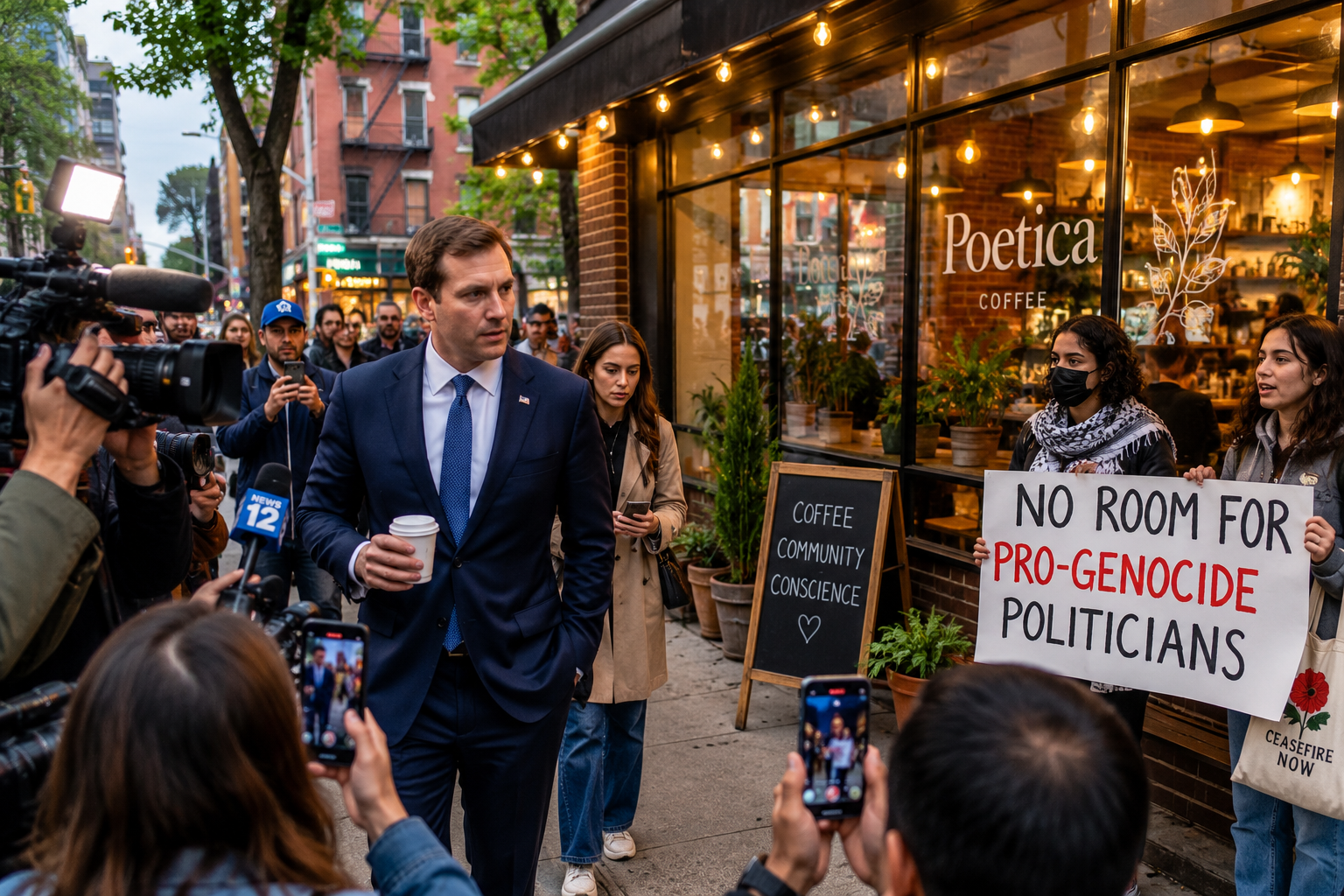
The Dan Goldman ban has turned a Brooklyn coffee shop into the center of one of New York’s most heated political fights. What looked like a simple café stop by Democratic congressman Dan Goldman quickly exploded into a public ban, a wave of backlash, and now a federal civil rights investigation. In a matter of hours, a neighborhood coffee run became a national argument about politics, antisemitism, protest, public accommodation, and whether a business can refuse someone over views tied to the Israel-Gaza war.
That is exactly why the Dan Goldman ban story has landed so hard. This is not just about whether a café owner likes a politician. It is about what happens when political outrage moves from social media anger into a public refusal, especially when the person being targeted is a Jewish congressman whose support for Israel has already made him a lightning rod in New York politics.
In a city already deeply tense over Gaza, the Dan Goldman ban became much bigger than one customer and one cup of coffee. Supporters of Goldman see it as discrimination disguised as activism. Defenders of the café see it as a moral stand against a politician they believe supports a devastating war. And now the federal government is stepping in to ask whether a legal line was crossed.
How the Dan Goldman Ban Started
The story behind the Dan Goldman ban began at Poetica Coffee in Brooklyn. Goldman, a Democratic congressman from New York, stopped by the café with his daughter and bought a coffee after she used the restroom. By Goldman’s own account, the interaction inside the shop was calm, polite, and completely ordinary.
The controversy began afterward.
Poetica Coffee later posted a now-deleted message online saying it would not have served Goldman if staff had recognized him at the time. The café accused him of supporting genocide because of his pro-Israel views and made it clear that he was not welcome back. It also refunded his purchase and publicly distanced itself from him.
That was the moment the Dan Goldman ban stopped being a neighborhood dispute and became a national political story.
Why the Café’s Message Triggered Such a Strong Reaction
The backlash came quickly because the café did not simply criticize Goldman. It publicly framed its decision as a moral rejection of him, accusing him of supporting atrocities and saying it would not knowingly serve him.
That changes the nature of the story.
The Dan Goldman ban raised a much bigger question than whether people are allowed to dislike a politician. It raised the question of whether a business that serves the public can refuse someone because of what that person represents politically, especially when the issue is tied to religion, identity, and one of the most emotionally charged conflicts in the world.
For Goldman and many of his supporters, the answer is no. They argue that the café crossed the line from protest into discrimination.
For others, especially those who support the café’s stance on Gaza, the issue looks different. They see the decision as an act of conscience by a business owner who does not want to serve someone they believe supports a humanitarian disaster.
That clash is exactly why the Dan Goldman ban has become so explosive. It sits at the intersection of politics, activism, identity, and civil rights law.
Dan Goldman Called the Incident “Sad” but Pointed to a Bigger Problem
Goldman’s response to the Dan Goldman ban added another layer to the story because he did not describe the visit itself as hostile. In fact, he said the encounter in the café had been pleasant. That matters because it suggests the conflict was not triggered by anything he did inside the shop. It was triggered by who he is and what he represents politically.
Goldman later said it was “sad” that the café treated him this way. But he also pushed the conversation beyond himself. He said the Justice Department should not focus only on a sitting congressman, but also on ordinary Jewish people who face antisemitism without the visibility or protection that comes with elected office.
That widened the meaning of the Dan Goldman ban. It stopped being only a story about a politician getting rejected by a café and became part of a much larger debate about antisemitism, public life, and the experience of Jewish New Yorkers in the current political climate.
Why the DOJ Is Now Investigating the Dan Goldman Ban
The Dan Goldman ban moved from controversy to legal scrutiny when the US Department of Justice launched a civil rights investigation into Poetica Coffee.
The DOJ’s Civil Rights Division said federal law bars places of public accommodation from discriminating on the basis of race, religion, or national origin. Investigators are now looking at whether the café’s actions were simply political expression or whether they crossed into unlawful discrimination.
That distinction is at the heart of the entire case.
A business owner can criticize a politician. A business owner can speak publicly about political beliefs. But if a public-facing business refuses service in a way that appears tied to Jewish identity or a protected category, the legal picture becomes far more serious.
That is why the Dan Goldman ban is no longer just a viral political fight. It is now a civil rights issue with federal attention.
Why This Case Is So Legally Sensitive
The legal tension in the Dan Goldman ban comes from the overlap between politics and identity.
Poetica Coffee appears to have targeted Goldman over his pro-Israel views. On its face, that sounds political. But Goldman is also a Jewish congressman, and critics argue that singling him out in this way may have crossed into discrimination that cannot simply be excused as activism.
That is what makes the case so difficult.
A café is allowed to have political opinions. It is allowed to criticize elected officials and take moral positions. But a place of public accommodation cannot unlawfully discriminate against customers on protected grounds. The DOJ investigation will likely focus on where that boundary sits in this case.
And that is why the Dan Goldman ban matters well beyond Brooklyn. It could become a test of how civil-rights law applies when public protest, religion, and the Israel-Palestine conflict all collide in one incident.
The Israel-Gaza War Is the Real Background to the Dan Goldman Ban
It is impossible to understand the Dan Goldman ban without understanding the atmosphere created by the Israel-Gaza war.
Goldman has been a strong supporter of Israel and has faced heavy criticism from pro-Palestinian activists for that position. Poetica Coffee’s message made clear that its anger was tied to his stance on the war and to broader accusations against politicians who back Israeli military action.
That context matters because it explains why this was never likely to remain a small local story. The war has become one of the most emotionally charged political issues in the United States, especially in cities like New York, where Jewish and Arab communities are both large, vocal, and deeply affected by events in the Middle East.
In that atmosphere, the Dan Goldman ban became more than a disagreement between one congressman and one café. It became a symbol of how global conflict is now spilling directly into everyday public life in America.
Why This Story Has Hit New York Politics So Hard
The Dan Goldman ban is not happening in a vacuum. Goldman is a sitting Democratic congressman in New York, and his views on Israel already place him inside a larger battle over the future of Democratic politics in the city.
New York has become one of the clearest places where the Israel-Palestine conflict is reshaping alliances, campaign messaging, and activist energy. Progressive groups, establishment Democrats, Jewish organizations, and pro-Palestinian activists are all fighting over the language and political consequences of the war.
That is why the café story blew up so quickly. It touched several raw nerves at once:
- The divide inside the Democratic party over Israel
- Growing concern over antisemitism
- The question of whether anti-Zionist activism can cross into anti-Jewish hostility
- The role of small businesses in public political protest
- The legal limits of refusing service in a politically charged case
All of those tensions are packed into the Dan Goldman ban, which is why it has drawn attention far beyond one Brooklyn storefront.
5 Big Questions Raised by the Dan Goldman Ban
The controversy has already gone far beyond one refunded coffee. It has raised several larger questions that will likely outlast the original incident.
1. Can a public business refuse service over politics?
This is the core question behind the Dan Goldman ban. A café can criticize a politician, but refusing service in a public-facing business is a very different matter.
2. When does anti-Israel activism become antisemitism?
This is one of the most sensitive issues in the case. Supporters of the café say the issue is Goldman’s politics. Critics say singling out a Jewish congressman in this way crosses a dangerous line.
3. Does moral protest override civil-rights law?
A business owner may believe they are acting on conscience. But civil-rights law does not disappear just because a refusal is framed as activism.
4. Should the DOJ be involved?
Some see the federal probe as necessary. Others argue it risks turning a political protest into a national legal spectacle.
5. What does this say about public life in New York?
The Dan Goldman ban suggests that the Israel-Palestine conflict is no longer confined to protests, speeches, or campaign events. It is now showing up in cafés, neighborhoods, and everyday public spaces.
Why the Dan Goldman Ban Matters Beyond One Coffee Shop
What makes the Dan Goldman ban so significant is not the coffee, the refund, or even the café itself. It is what the incident reveals about the political moment.
Public life in America is becoming more confrontational. People are no longer satisfied simply to criticize public figures. Increasingly, they want to deny them normal treatment, exclude them from public spaces, or make them symbols of everything they oppose. At the same time, civil-rights law still places limits on how far public-facing businesses can go, especially when religion or national origin may be involved.
That is why the Dan Goldman ban matters beyond Poetica Coffee. It forces a bigger conversation about whether every local business is becoming a new front in the culture war, and what happens when moral certainty collides with legal responsibility.
Final Thoughts
The Dan Goldman ban has turned a Brooklyn café dispute into a much larger fight over politics, identity, protest, and public accommodation. What began as a quick stop for coffee with his daughter ended with a public ban, a wave of backlash, and a federal investigation that now raises serious questions about discrimination and activism in New York.
The facts of the case are still being debated, and the legal process will matter. But one thing is already clear: this story is about far more than one congressman being told not to come back. It is about the temperature of American politics, the pressure surrounding the Israel-Gaza war, and the way those tensions are spilling into ordinary public spaces.
If the Dan Goldman ban becomes a legal test case, it may help define where protest ends and unlawful exclusion begins. And even if it does not, it has already shown how quickly a neighborhood coffee shop can become the center of a national argument when politics, identity, and moral outrage collide.
Read Other Interesting news here: UK Prime Ministers
