

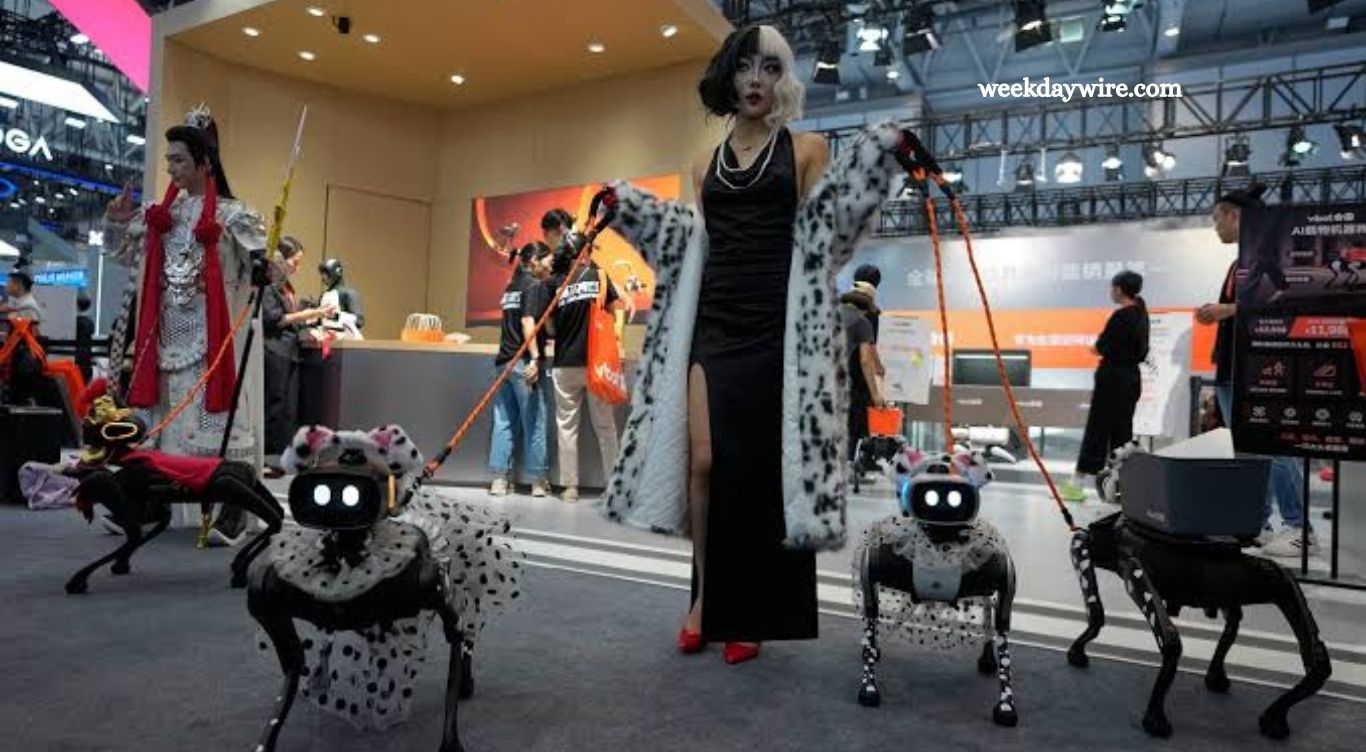
China’s rapidly growing robotics sector took center stage in Beijing as the 2026 World Robot Conference opened with humanoid machines, four-legged robot dogs, industrial systems, and experimental household helpers. The event offered visitors a close look at how Chinese technology companies are trying to transform robots from eye-catching demonstrations into machines capable of performing useful work in factories, homes, healthcare settings, and other environments.
Thousands of robotic products are expected to appear during the five-day conference, reflecting China’s increasing investment in automation and artificial intelligence. Visitors can watch robots dance, compete in boxing demonstrations, interact with people, move industrial components, and attempt everyday household activities. While many displays highlight impressive progress, they also reveal how much development is still required before advanced robots become reliable assistants in daily life.
Read More: Irankunda Reveals Hanson’s Monoculture Remarks Upset Socceroos at World Cup
Beijing Conference Highlights China’s Growing Robotics Industry
Organizers say roughly 3,000 robotic products will be displayed during the conference. The wide range of machines demonstrates how quickly China’s robotics industry has expanded, particularly in humanoid robots, industrial automation, artificial intelligence, and four-legged robotic platforms. Chinese companies are increasingly competing to develop machines that can operate outside controlled laboratories.
Although the gathering is called the World Robot Conference, Chinese companies dominated the exhibition. The event provides domestic manufacturers with an important opportunity to demonstrate new technologies, meet potential customers, and attract investors. It also allows visitors to see how robotics companies are attempting to solve challenges involving movement, balance, object recognition, communication, and human interaction.
Unitree Humanoid Robots Attract Major Attention
One of the busiest areas of the conference belonged to Unitree, a prominent Chinese manufacturer known for humanoid robots and robotic dogs. Its machines entertained visitors through demonstrations that included dancing, boxing, and other coordinated movements designed to show improvements in balance, flexibility, and artificial intelligence.
One Unitree humanoid also demonstrated its ability to play table tennis against a human participant. Such demonstrations may primarily provide entertainment, but they also help showcase important technical capabilities such as visual tracking, fast movement, hand-eye coordination, and real-time decision-making. Unitree’s participation attracted additional interest because the conference began around the same time as the company entered the Shanghai stock market.
Industrial Robots Move Toward Practical Applications
Entertainment was only one part of the exhibition. Several manufacturers displayed machines designed for practical industrial applications, particularly tasks that could eventually reduce reliance on repetitive manual labor. Robots equipped with mechanical hands and articulated arms demonstrated their ability to pick up objects, transport components, and perform movements similar to those required on manufacturing lines.
UBTECH Robotics was among the companies presenting industrial humanoid systems. Its machines demonstrated tasks involving the movement and handling of components. Industrial environments may provide some of the earliest large-scale opportunities for humanoid robots because factories contain repetitive processes where machines can operate within relatively predictable surroundings.
Humanoid Robots Designed for Emotional Support
Another major area of interest involves humanoid robots designed to communicate directly with people. Instead of focusing only on manufacturing or transportation tasks, some companies are developing robots intended for companionship, emotional support, customer service, and personal assistance.
UBTECH displayed a humanoid robot capable of speaking, changing facial expressions, turning its head, and moving its hands while interacting with people. According to company representatives, the robot is available for individual customers and costs approximately 168,000 yuan, equivalent to more than $24,000. The high price means such systems remain expensive for most households, but companies believe improvements in production could eventually make similar robots more accessible.
Robot Dogs Continue Expanding Their Capabilities
Four-legged robots, commonly called robot dogs, were another important part of the conference. These machines are designed to travel across environments that may be difficult for traditional wheeled robots. Their ability to walk, climb, maintain balance, and navigate uneven surfaces creates possibilities for industrial inspections, emergency response, security operations, and research.
Chinese technology companies have become increasingly active in the development of quadruped robots. Improvements in motors, batteries, sensors, and artificial intelligence have allowed newer models to move faster and respond more effectively to their surroundings. Some robot dogs are designed primarily for research and demonstrations, while others are being developed for commercial or industrial applications.
Robotics Industry Faces International Restrictions
China’s robotics expansion is taking place alongside growing international concerns involving cybersecurity, technology competition, and national security. Shortly before the Beijing conference, the U.S. Federal Communications Commission announced restrictions affecting imports of certain newly produced foreign humanoid and quadruped robots.
U.S. regulators have argued that advanced connected robots could potentially create cybersecurity or national security risks because they may contain cameras, microphones, sensors, wireless connections, and sophisticated software. The measures particularly affect technologies associated with Chinese manufacturers. Such restrictions demonstrate how robotics is increasingly becoming part of broader international debates surrounding artificial intelligence, data security, and technological competition.
Simple Household Tasks Remain Difficult
Despite impressive demonstrations involving dancing, boxing, and humanlike movements, the conference also highlighted the limitations of current robotics technology. Tasks that seem extremely simple for people can remain surprisingly complicated for machines, especially when they involve flexible objects or unpredictable environments.
At one demonstration, a robot equipped with mechanical arms attempted to fold a shirt. Although the activity appeared straightforward, the machine struggled to complete it even after several minutes. Fabric can wrinkle, bend, overlap, and move unpredictably, requiring constant adjustments. The demonstration showed why household robotics remains a difficult engineering challenge despite rapid improvements in artificial intelligence.
Humanoid Robots Still Developing Practical Skills
Experts continue to debate how quickly humanoid robots can become genuinely useful workers. Modern machines can walk, dance, communicate, lift objects, and perform carefully prepared demonstrations, but operating reliably for long periods in complex real-world environments remains considerably harder.
Factories, homes, hospitals, and public spaces contain unexpected situations that robots must understand and respond to safely. Companies therefore need to improve artificial intelligence, batteries, sensors, mechanical durability, hand control, and decision-making. Lower production costs will also be essential if humanoid robots are expected to move beyond specialized industries and wealthy early adopters.
China Pushes Robotics Toward Everyday Use
China has made robotics an increasingly important part of its broader technology and manufacturing ambitions. Automation could help factories improve productivity while humanoid systems may eventually perform jobs involving logistics, maintenance, customer assistance, elderly care, and other services.
The World Robot Conference illustrates both the remarkable progress and continuing limitations of this technology. Robots can now perform movements that appeared highly experimental only a few years ago, yet something as ordinary as folding clothing can still prove difficult. As companies continue investing in artificial intelligence and advanced hardware, the next major challenge will be turning impressive demonstrations into dependable machines that provide meaningful value in everyday situations.
Frequently Asked Questions
What is the World Robot Conference 2026?
It is a major robotics event in Beijing showcasing thousands of advanced robotic products and technologies.
Which Chinese robotics companies attracted attention at the conference?
Unitree and UBTECH were among the leading companies presenting humanoid and industrial robots.
What can Unitree humanoid robots do?
They can dance, box, play table tennis, and demonstrate advanced movement and coordination.
Are humanoid robots available for personal use?
Yes, some models are available to individual buyers, although they remain expensive.
What are robot dogs used for?
Robot dogs can support inspections, research, emergency response, security, and work in difficult terrain.
Can robots perform household tasks easily?
Not always. Tasks such as folding clothes can still be difficult for current robotic systems.
What is China trying to achieve with robotics?
China aims to expand robotics across factories, services, homes, healthcare, and other real-world applications.
Conclusion
China’s 2026 World Robot Conference shows how quickly the country’s robotics industry is advancing. From humanoid robots and robot dogs to industrial machines and emotional-support systems, companies are exploring new ways to bring robotics into factories, homes, healthcare, and everyday services. The event also highlights China’s growing role in artificial intelligence, automation, and advanced manufacturing.
