

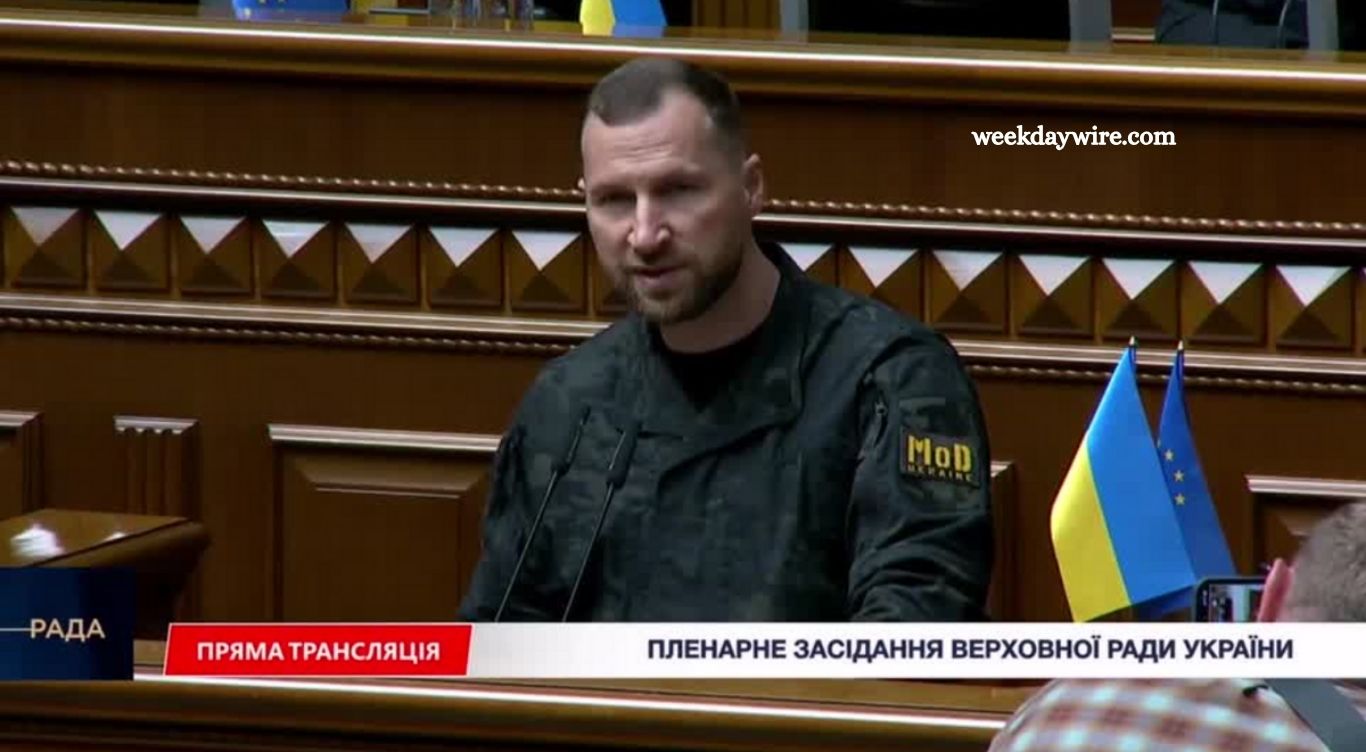
Ukraine has appointed Yevhenii Khmara as its new defence minister, bringing a former special forces commander into one of the country’s most important wartime positions. His appointment comes during a difficult period for Ukraine, with Russian attacks continuing, military pressures increasing and political tensions growing in Kyiv.
Khmara replaces Mykhailo Fedorov, whose removal after a relatively short period in office has generated controversy. Fedorov, a prominent technology-focused reformer and former digital transformation minister, has since launched a public challenge to the government by calling for wartime elections. His comments have added another layer of political uncertainty as Ukraine continues its fight against Russia.
Yevhenii Khmara Takes Over Ukraine’s Defence Ministry
Khmara enters the defence ministry with experience in Ukraine’s security and military structures. Before receiving the defence portfolio, he served as a special forces commander and temporarily headed the Security Service of Ukraine.
His background is markedly different from that of Fedorov, who became widely associated with digital modernization, military technology and efforts to expand Ukraine’s use of drones and other innovative systems.
Read More: 2026 Championship Meets: Pallister Dominates Women’s Individual Events
The change reflects the increasingly demanding security environment facing Ukraine. Russian missile and drone attacks remain a major threat, while Ukrainian forces continue to face intense pressure along the front. Khmara will therefore inherit a ministry responsible not only for military planning but also for procurement, weapons supplies, international defence cooperation and support for Ukraine’s armed forces.
Fedorov’s Dismissal Triggers Political Debate
Fedorov’s departure followed a broader government reshuffle by President Volodymyr Zelenskiy. His dismissal was controversial because supporters credited him with helping modernize Ukraine’s defence capabilities during his time in office.
His removal also sparked protests in Kyiv and other Ukrainian cities, highlighting concerns among some Ukrainians about the government’s decision. Reuters reported that Fedorov’s subsequent attempt to expand the political dispute by calling for elections did not attract the level of support he appeared to seek.
Fedorov has argued that Ukraine needs major changes to its approach to the war and its governance. In later comments, he warned that the country could gradually lose the war without significant reforms, while criticizing what he described as weaknesses in strategy, innovation and the use of technology.
Fedorov Calls for Wartime Elections
One of the most significant developments following Fedorov’s dismissal was his public call for Ukraine to hold elections during wartime.
Fedorov argued that Ukraine was facing a governance crisis and said elections were necessary. His statement represented one of the strongest internal political challenges to Zelenskiy since Russia launched its full-scale invasion.
The issue is particularly sensitive because Ukraine remains under martial law as it fights Russia. Holding national elections during an active war presents substantial legal, logistical and security challenges.
Fedorov’s call also divided public opinion. While some viewed elections as an important democratic safeguard, others argued that conducting a nationwide vote while Russian attacks continue could create serious risks and undermine national stability.
Corruption Adds Pressure on Zelenskiy’s Government
Khmara’s appointment also comes as Ukrainian anti-corruption authorities investigate allegations involving people close to the presidential administration.
According to Reuters, investigators charged a deputy head of Zelenskiy’s office in connection with a money-laundering case involving approximately $3 million. The investigation increased pressure on the government and intensified public scrutiny of Ukraine’s political leadership.
Corruption has remained a major political issue in Ukraine throughout the war. Kyiv has repeatedly faced demands from citizens and international partners to strengthen transparency, improve government accountability and ensure that military resources are used effectively.
For Khmara, maintaining confidence in the defence ministry will therefore be almost as important as managing its military responsibilities.
A Difficult Military Environment
The new defence minister takes office while Ukraine continues to face relentless Russian attacks.
Russian missile and drone strikes have targeted Ukrainian cities and critical infrastructure, while Ukrainian forces continue defending positions across the front. The pressure on Ukraine’s air-defence capabilities has become especially significant as Russia increases the scale and frequency of aerial attacks.
Recent Reuters reporting has highlighted the continuing intensity of the conflict, including large-scale Russian drone and missile attacks against Ukrainian territory.
The defence ministry must coordinate Ukraine’s response while ensuring troops receive sufficient weapons, ammunition, equipment and other supplies.
Western military assistance remains another crucial part of the equation. Ukraine continues to rely heavily on support from European countries and the United States, particularly for advanced air-defence systems and other high-value military equipment.
Technology Remains Central to Ukraine’s Defence Strategy
Although Fedorov is no longer defence minister, many of the technological priorities associated with his tenure are likely to remain important.
Ukraine has become a major testing ground for drone warfare, autonomous systems and battlefield technology. Both sides increasingly rely on unmanned aerial systems for reconnaissance, targeting and attacks.
Fedorov previously promoted greater use of technology in Ukraine’s military strategy. After leaving office, he continued arguing that Ukraine’s technological capabilities could play a decisive role in the conflict. He has specifically highlighted autonomous drones and artificial-intelligence-supported weapons as areas where Ukraine could strengthen its military advantage.
Khmara will therefore face the challenge of balancing traditional military structures with the rapid technological changes transforming modern warfare.
What Khmara’s Appointment Means for Ukraine
The appointment signals a significant shift at the top of Ukraine’s defence establishment.
Khmara’s security and military background could provide a more conventional leadership approach at a time when Ukraine is facing intense battlefield pressure. At the same time, the government will need to maintain momentum in military innovation, particularly in drone development, electronic warfare and advanced defence technologies.
His immediate priorities are likely to include strengthening military readiness, improving coordination between security institutions, securing international military assistance and addressing concerns surrounding defence spending and procurement.
The political environment could make those tasks even more difficult. Fedorov’s continued public criticism means the government must manage an internal political dispute while concentrating on the war.
Ukraine Faces Major Challenges Ahead
Ukraine’s leadership change comes at a critical moment in the war. Russian attacks continue, military resources remain under pressure, and diplomatic efforts to end the conflict have yet to deliver a lasting settlement.
At the same time, Ukraine faces financial challenges. Reuters recently reported that lawmakers failed to approve a parcel-tax measure connected to international financial support, while the government warned of a substantial defence funding gap.
These financial pressures will directly affect the defence ministry’s ability to maintain military operations and invest in new capabilities.
Khmara therefore begins his tenure with responsibilities extending far beyond military administration. He must help Ukraine sustain its defence effort, maintain relationships with international partners and navigate growing domestic concerns over governance and accountability.
Frequently Asked Questions
Who is Ukraine’s new defence minister?
Yevhenii Khmara, a former special forces operative, was appointed Ukraine’s new defence minister on August 19, 2026.
Who did Yevhenii Khmara replace?
Khmara replaced Mykhailo Fedorov, who was dismissed from the defence ministry after several months in the position.
Why was Fedorov’s dismissal controversial?
Fedorov’s removal triggered protests and political debate, with supporters questioning the decision and demanding changes within the government.
What did Fedorov call for after leaving office?
Fedorov called for Ukraine to hold elections during wartime, arguing that democratic processes should continue despite the ongoing war.
What experience does Khmara bring to the defence ministry?
Khmara previously served in Ukraine’s special forces and held senior roles within the Security Service of Ukraine, giving him extensive wartime security experience.
What challenges does Khmara face as defence minister?
He faces major challenges including military funding shortages, battlefield pressures, air-defence needs, defence planning and maintaining international support.
Why is Khmara’s appointment important for Ukraine?
His appointment comes during significant military and political pressure, making his leadership important for Ukraine’s war strategy, defence planning and relations with international partners.
Conclusion
Yevhenii Khmara’s appointment marks a major shift in Ukraine’s defence leadership during a critical stage of the war. As a former special-forces commander, he takes charge while Ukraine faces battlefield pressure, funding shortages and growing demands for stronger military planning.
