

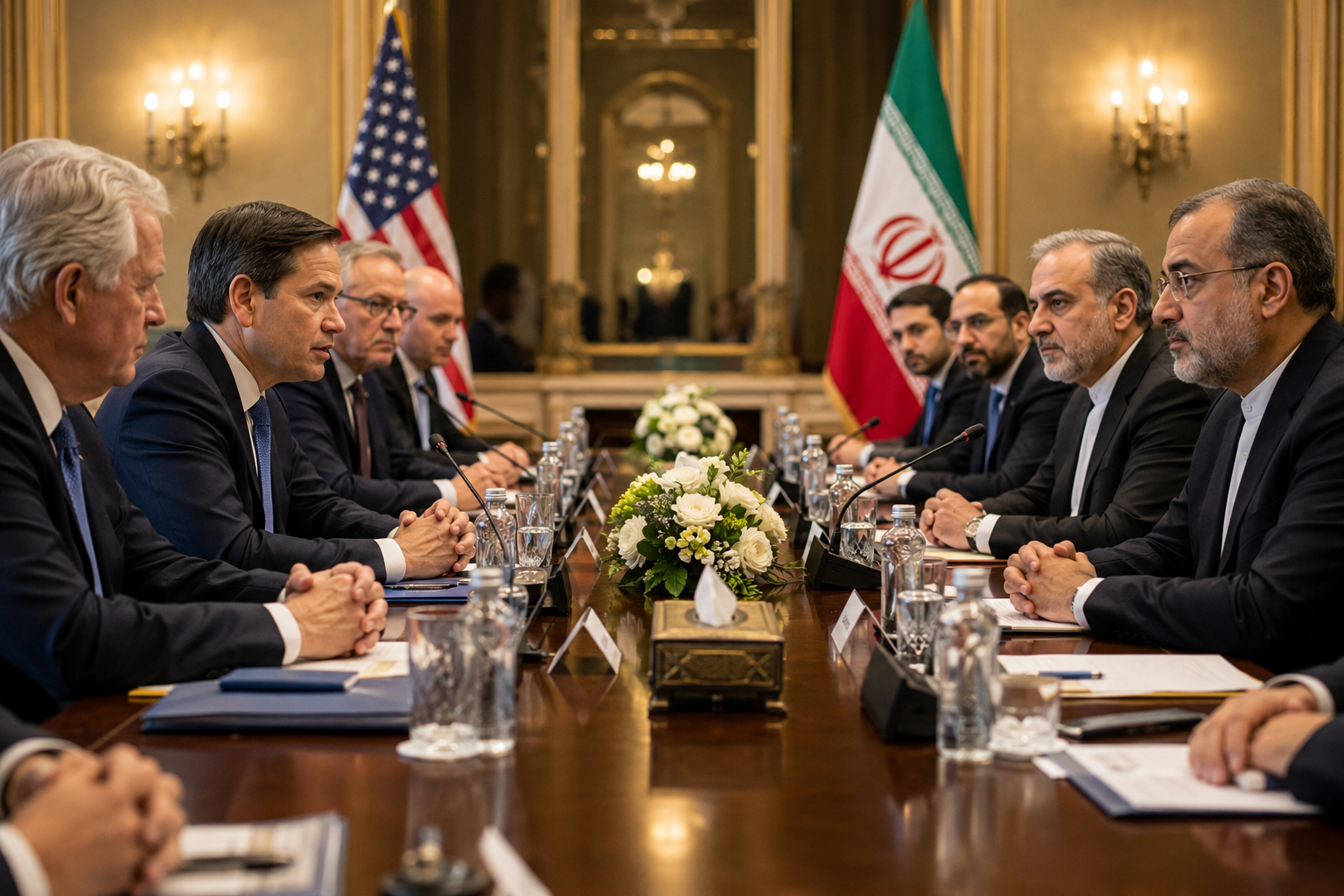
The latest US Iran talks ended their first day with a mix of hope, caution, and clear disagreement. While officials from both sides described the meeting as constructive, the reality is more complex. The US Iran talks did produce some movement on sanctions and regional stability, but they also exposed deep divisions on frozen Iranian assets, nuclear inspections, and Tehran’s growing uranium stockpile.
That is why these US Iran talks matter so much. They are not just another diplomatic meeting. They are an attempt to lower tensions after a dangerous period in the region and possibly build a path toward a wider agreement. But after day one, it is clear that major obstacles still stand in the way.
Why the First Day of Talks Mattered
The first round of US Iran talks came at a critical moment. Tensions between Washington and Tehran had been rising, and concerns about military escalation, oil routes, and nuclear activity were growing again. Against that backdrop, simply getting both sides into a serious room for discussion was an achievement in itself.
Still, the goal of the US Iran talks was never to solve every issue in a single day. The first session was more about testing intentions, building a process, and finding out whether both governments were willing to move from pressure to diplomacy. In that sense, the talks did create momentum.
Both sides signaled that they wanted the process to continue. That alone gave the US Iran talks an importance that goes beyond one meeting. Investors, regional governments, and diplomats are all watching to see whether this opening round becomes the start of a larger breakthrough.
What the US and Iran Agreed On
One of the clearest signs of progress in the US Iran talks was the agreement to keep negotiating through working groups. That may sound procedural, but it matters. It means the first day did not collapse into accusations or deadlock. Instead, both sides left the room with a framework for follow-up discussions.
There were also two major areas where the US Iran talks appeared to produce early movement.
A 60-Day Waiver on Iranian Oil
The United States agreed to a 60-day waiver on sanctions related to Iranian oil. This is one of the most significant early outcomes because oil remains central to Iran’s economy. Even temporary relief can make a difference for Tehran, especially when sanctions have been weighing heavily on trade and revenue.
For Washington, the move is also strategic. It allows the United States to show flexibility in the US Iran talks without giving up all of its leverage at once. It creates space for diplomacy while still keeping pressure on the bigger issues.
A Communication Line on the Strait of Hormuz
Another important step in the US Iran talks was the decision to open a communication line regarding the Strait of Hormuz. This waterway is one of the world’s most important energy routes, and any tension there can shake global markets within hours.
By setting up direct communication, both sides appear to be trying to reduce the risk of miscalculation, naval incidents, or sudden escalation. Even if the broader US Iran talks take time, this step could help calm one of the most sensitive areas in the region.
Frozen Iranian Assets Exposed a Major Disagreement
Despite the progress, one of the biggest disputes in the US Iran talks quickly centered on frozen Iranian money.
Iranian officials said the United States had agreed to release $12 billion in frozen Iranian assets. If fully confirmed, that would be one of the biggest concessions in the talks so far and a major financial gain for Tehran.
But Washington presented the issue differently.
American officials indicated that any released funds would move through controlled channels and would be used for specific purposes, especially food and medical supplies. Donald Trump also said the money would help Iran buy products from American farmers, including corn, wheat, and soybeans.
Iran rejected that condition.
Iranian Foreign Ministry spokesman Esmaeil Baghaei argued that Iran should be free to spend its own money on whatever goods its people need. This disagreement shows one of the central problems in the US Iran talks: both sides may agree on a headline, but they do not agree on the meaning behind it.
Nuclear Inspections Remain One of the Toughest Issues
Another major gap in the US Iran talks appeared over nuclear inspections.
US Vice President JD Vance said Iran had agreed to allow inspectors from the International Atomic Energy Agency (IAEA) back into the country. That would be a major step if confirmed, because inspections are a core demand from Washington.
Iran, however, pushed back almost immediately.
Iranian officials said there was no agreed schedule for IAEA inspections and that there had been no direct meeting with IAEA Director General Rafael Grossi on the matter. That response suggested that the US and Iran were not describing the same outcome from the first day of talks.
This matters because inspections sit at the center of the US Iran talks. Without them, Washington is unlikely to trust any promise about Iran’s nuclear programme. But for Tehran, the issue is tied to sovereignty, security, and domestic politics. That makes it one of the hardest points to settle.
Why IAEA Access Is So Important
The IAEA has long been a central part of the Iran nuclear issue. Under the 2015 nuclear deal, also known as the JCPOA, the agency was responsible for monitoring Iran’s compliance with agreed limits.
That deal changed the diplomatic landscape at the time, but it later unraveled after the United States withdrew in 2018 during Trump’s first term. Since then, trust has eroded, and the role of inspections has become even more politically sensitive.
In the current US Iran talks, the inspection issue is not just technical. It is symbolic. For the United States, IAEA access is proof that Iran is serious about limits and transparency. For Iran, the same demand can feel like a one-sided condition imposed under pressure.
That is why this part of the US Iran talks may take much longer to resolve than some of the other issues on the table.
Iran’s Uranium Stockpile Is Still a Serious Obstacle
No matter how much progress the US Iran talks make on sanctions or shipping routes, the uranium issue remains one of the biggest barriers to a lasting agreement.
Under the 2015 JCPOA, Iran was allowed to enrich uranium only up to 3.67 percent, a level suited for civilian nuclear energy. But Iran is now believed to hold 440 kilograms of uranium enriched to 60 percent.
That number matters because 60 percent enrichment is much closer to weapons-grade levels, which are around 90 percent. It is still below that threshold, but it is far beyond the limits set under the earlier agreement.
Washington has pushed for Iran to give up this enriched uranium stockpile. Tehran has repeatedly rejected the idea of handing it directly to the United States. That leaves the US Iran talks searching for a middle path.
Possible options could include sending the stockpile to a third country or diluting it inside Iran. But so far, no final arrangement has been confirmed. Until this issue is addressed, the US Iran talks will continue to face a major credibility challenge.
The Strait of Hormuz Keeps Global Pressure on the Talks
The US Iran talks are not only about nuclear diplomacy or sanctions. They also matter because of the Strait of Hormuz, one of the most important energy chokepoints in the world.
A huge share of global oil and gas shipments passes through this narrow route. Whenever tensions rise there, the impact is felt far beyond the Middle East. Energy prices can jump, shipping risks increase, and global markets become more nervous.
That is why the communication channel created during the US Iran talks could be one of the most useful early results. It may not solve the deeper political disputes, but it can reduce the risk of sudden escalation in a place where a single incident could have global consequences.
In that sense, part of the value of the US Iran talks lies in crisis management as much as in long-term diplomacy.
5 Major Gaps Still Hanging Over the Negotiations
Even after a full day of discussions, the US Iran talks left several major questions unanswered. These are the gaps that could shape the next phase of diplomacy:
1. Who controls the frozen Iranian assets?
Iran wants real access to the $12 billion it says is being released. The United States appears to want conditions and oversight.
2. Will IAEA inspectors actually return?
Washington says yes. Tehran says there is no confirmed schedule. This remains one of the biggest unresolved issues in the US Iran talks.
3. What happens to Iran’s 60 percent enriched uranium?
This is one of the hardest technical and political questions on the table. A lasting deal will almost certainly need a clear answer.
4. Is the oil sanctions waiver temporary or the start of broader relief?
The 60-day waiver is important, but it is still only a short-term measure. Iran will want to know whether wider relief is possible.
5. Can both sides turn day-one momentum into a real roadmap?
The first day of US Iran talks created a process, but process alone is not enough. The real test will come in the next rounds.
What the Talks Could Mean for the Region
The outcome of the US Iran talks could shape the wider Middle East in a major way. If the talks continue moving forward, they could lower the risk of military escalation, ease pressure on global energy markets, and create space for broader diplomacy in the region.
If they fail, the opposite could happen. Tensions around oil routes could rise again, nuclear fears could deepen, and both countries could return to a cycle of confrontation. That is why the US Iran talks are being watched so closely not just in Washington and Tehran, but across the Gulf and beyond.
The stakes are simply too high for this process to be treated as routine diplomacy.
Final Thoughts
The first day of US Iran talks delivered real movement, but it did not deliver a breakthrough. There was progress on oil sanctions, a practical step on the Strait of Hormuz, and enough momentum to keep negotiations alive. But the biggest disputes remain unresolved.
Frozen Iranian assets, nuclear inspections, and Iran’s uranium stockpile continue to divide both sides. Those are not small details. They are the core of the entire negotiation.
For now, the US Iran talks have opened a door. Whether that door leads to a serious agreement or another dead end will depend on what happens next. If both sides stay engaged and show flexibility, these talks could become a turning point. If not, day one may end up being remembered as a promising start that could not overcome the same old mistrust.
Read Other Interesting news here: Tech Logiest Review
